Showing posts with label 40D. Show all posts

Monday, May 11, 2009

Shooting Waterfalls

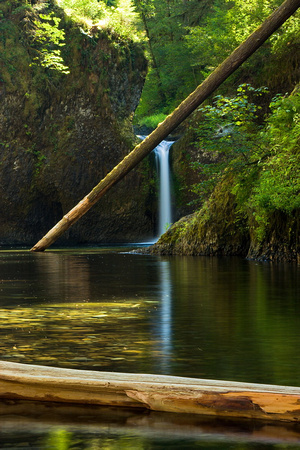
Image: Punchbowl Falls, 40D, 24-105 f4 L IS, f22, 2.5 sec, 65 mm.
Larger Image

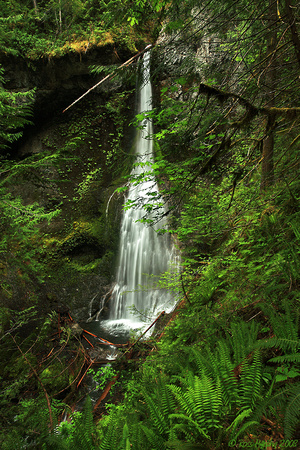
Image: Marymere Falls 40D, 17-40 f4 L, f11 1/5 sec, 25 mm.
Larger Image

One of my favorite things to shoot, especially in the Columbia river Gorge, on the Oregon side.
Shooting waterfalls can be quit difficult, the contrast between the water and the surrounding landscape can be extreme to say the least and if sun light is landing on the water it becomes most times impossible to get a good shot. I prefer to shoot falls that are shaded when the contrast is closer between the falls and the surrounding area, this makes those over cast wet days great for getting out and exploring nearby waterfalls. Depending on conditions I may use a CPL or even a GND filter, I like to shoot them under one second to avoid to much of the misty water look, however some times when shooting in the canopy of the forest you may have to up the ISO to get the speed you want. Be creative and experiment, some time's a longer exposure works. A CPL or GND can help you get the longer exposure and by metering on the water (use exposure lock) and then recompose and focus on a foreground subject to add interest, you can get a nice even exposure, by metering on the brighter water the longer exposure will bring enough light to the surrounding area, remember if your foreground is not in focus the shot is ruined.

Ross Murphy Images In Light

Monday, April 6, 2009

Filters in the digital age


Image: Canon 5D and 17-10 F4 L, Lee 3 Stop GND filter, f11 at 17 mm, no crop.
 Larger Image

Filters are still required in the digital age of photography, not as much as they where in the film days, but in order to get proper exposure on a lanscape that has a very wide dynamic range or to remove reflections from water, we still resort to using filters.


The main filter system in my bag is the Lee Graduated Nuetral Density filter or GND for short. The main task of these filters is to reduce the amount of light contacting the camera sensor while still being able to use the lens aperture you need. Graduated filters, as the name implies, start the transition from the center of the filter and graduate to the edge in varying degrees, measured in stops.

The top photo is an example of where a GND filter is needed, if a filter was not used and you where to meter on the sky the land would be under exposed or if you metered on the land the sky would have been over exposed, in this image a 3 stop filter was used to even out the overall exposure. The filters I use are made by Lee and Singh-Ray I use the foundation kit with 4 x 6 filters, for wide angle I use there special wide angle hood with one filter slot. I carry a 1, 2 and 3 stop GND a 3 stop reverse GND and an 8 stop variable ND. The reverse filter is for shots like a sunset or sunrise where the brightest part of the image is closer to the middle of the image. The variable ND is a great filter for shooting seascapes, this is a filter that I will talk about in another blog.

 The Lee Big Stopper a 10 stop ND filter for maximizing the effect.

Circular Polarizer: The CPL is another filter that is still required for reducing reflections and a good quality filter should be used to prevent color cast's. B + W is my choice, I use the slim 77mm and reducing rings when needed. These filters also increase the color saturation of trees and blue skys and add contrast to clouds, there should be one in every photographers bag. A word of caution on CPL and wide angle landscapes, if you have a lot of blue sky the CPL will only cover part of the sky and you will end up with un-even polarization that will ruin your image.

Ross Murphy Images In Light