Showing posts with label Panorama. Show all posts

Wednesday, October 7, 2009

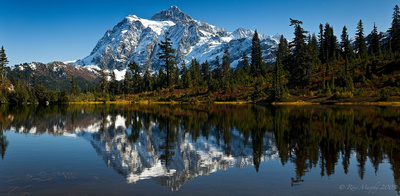
More from Shuksan


Image: 5D Mk II, 24-105 f4 IS L at 50mm, CPL and 3 stop GND soft
This is an image I have been wanting to get with the 5D Mk II, its a 2 shot panorama of Mt Shuksan with the fall colors and fresh snow on the mountain, I look forward to getting this one printed and framed. The 24-105 f4 at 50mm is deadly sharp on the Mk II and is a combination thats hard to beat. Right now I am very happy with the lenses I have, I do wish I could afford a 400mm f4 DO. Canons f4 series of lenses are a blessing for outdoor photographers that want to travel light and the cost is a blessing also over their f2.8 cousins.

Ross Murphy Images In Light

Wednesday, September 2, 2009

More About Panoramas

Image: crop from image just below this. click image to view larger.


Image 5D Mk II 70-200 f4 IS L, 5 Shot panorama. click image to view larger.

Image 5D Mk II 70-200 f4 IS L, 2 Shot panorama.

Larger Image

Here is a good reason not to shoot panoramas to wide, if you plan on framing the top, 5 shot panorama, it would cost a fortune at 17" x 62" which is where you would need to be to have a decent height where the lower 2 shot panorama could be printed at a much more manageable size of 17" x 31", it is also much better for viewing on line, I try to max my horizontal panoramas to 3 shots with overlaps. Now if I do portrait mode panoramas I will do a minimum of 3 to 5 shots and preferably 7 seems to be about right in portrait mode and I would have done it here but the water was to rough and there was no reflection to speak of. Shot on a Gitzo 3530s tripod with a BH-1 ball head, stitched in CS4. The big one is fun to view on 2, 20" monitors though I must admit, the detail is pretty amazing. Glass size also comes in to play, limiting my images to about 42" in length, without inducing massive extra cost.

Ross Murphy Images In Light

Thursday, July 16, 2009

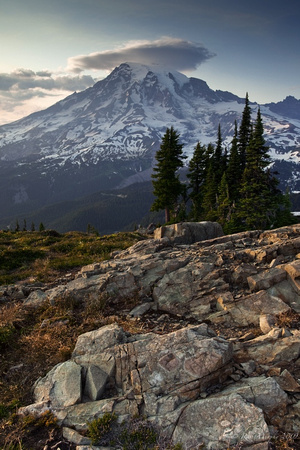
Wide Angle Landscape Shooting

Image: Mt Tahoma (Indian Name) 5D Mk II, 17-40 f4 L, 29mm @ f16, 1/6 sec. 3 Stop GND

Larger Image

Shooting wide angle landscapes is one of my favorites, I have found that the key is to have a foreground subject that is tack sharp, the shot should feel balanced weight wise and if possible use the rule of thirds, this is where the new tilt/shift lenses should excel. prints from these types of images can be a challenge but when you get that shot where it all comes together the wide angle landscape can be gorgeous hanging on your wall. A GND filter is a big help in this type of image, I want to spend my time in the field not behind a computer trying to put HDR's together, I spent maybe 5 minuets putting the above image through Lightroom and CS4.

Ross Murphy Images in Light

Wednesday, April 29, 2009

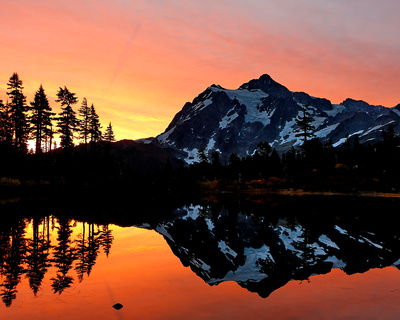
Light and the landscape


Image: Mt Shuksan sunrise, 30D, 17-40 f4 L , f9, 19mm,GND filter, CPL. Tripod, Ball Head.

larger image here

The Magic hour, this is the time I go out if I hope to make a dramatic image, I want to be on location just prior to sunrise or sunset, preferably a place that was pre-scouted. The magic hour light is when landscape's are most dramatic, some times it can start well before the sun comes up or long after it has set, I don't know how many times I have been working a location at sunset, when as soon as the sun drops behind the horizon people are leaving for their cars, often times this is the best time to stay and photograph a landscape. I have stumbled up trails at 4:00 in the morning to reach a place, in time to get set up for sunrise. This is what landscape photography is all about, often you can come away with an image that no one will ever see, even if they have stood in the very same place as you.

Ross Murphy Images In Light

Monday, March 23, 2009

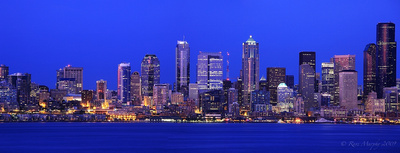
Night Fall


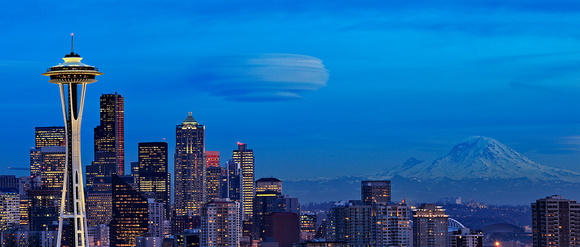
Image: 5D Mk II, 24-105 F4 L IS, 2 shot panorama

Dusk:


The Beginning of Darkness, that time between Sunset and Night. This is my favorite time to photograph a cityscape. The sky normally turns a bright blue before going gray to black, the lights in the buildings are on by this time and you get the blue sky and the building lights, the contrast is just right for evening cityscape's.

Ross Murphy Images In Light

Tuesday, March 17, 2009

Sharpest zoom ever ? - Canon EF 70-200 f4 L IS


Photo: 5D MkII and 70-200 f/4L IS, 2 shot panorama

Maybe,
One of the eternal questions for Canon owners is which 70-200 should I get ? Of the 4 to choose from, they are all very good, but with a range in cost of $500 to $1700 how does one choose ?, I have had the 70-200 f2.8 L, 70-200 f2.8 IS L and presently the 70-200 f4 IS L. All three of these len's where sharp. I purchased the original back in my film days and enjoyed it, at one point it was stollen so my re-purchase was the 2.8 IS version (at the time there was no f4 IS), the "IS" or image stabilization is an amazing feature that works exceptionally well. So I had a trip comming up and this caused a problem, which lens's to take with me ? I realy wanted to take the 17-40, 24-105, 70-200, 300 f4 and one body, but these would not all fit in my bag of choice, not to mention the weight would be prohibative to pack around all the time. My solution ? buy the 70-200 f4 IS, try it out and sell the loser. keep in mind that for me the bokeh of the f2.8 was not that important, I have other lens's for portrait shots and the 1 stop differance between f2.8 and f4 is not enough to matter for low light shooting, for that you want f1.4 len's. So after recieving the f4 IS version and trying it out on a skyline shot of Seattle I became convinced, at half the weight, a $600 savings, one stop better image stabalization and getting a sharper lens, to me there was no competition, I sold the f2.8 IS version, in a perfect world I would have kept both, but in these times of economic turmoil, not going to happen. Oh and this allowed me to fit all the lens's I wanted in to my carry on bag, and made my life a lot easier.
So if you want one of these lens's you need to juggle, weight, cost, speed and image stabilization, as far as IQ is concerned, they are all very nice and you can't go wrong there. If its portrait work, its got to be one of the 2.8 versions, I think for most other applications f4 should suit most people fine. Photography has always been about trade offs, this is just another one those.

My recommendations are as follows:

for portrait work: 70-200 f/2.8L IS II

for all other work: 70-200 f/4L IS

for cost saving: 70-200 f/4L


Update: the newest member, the EF 70-200 f/2.8L IS II, at around $2300 trumps them all, yes its worth it, I upgraded to the EF 24-70 f/2.8L II and it is also well worth the money.

Kai says it all here 

Ross Murphy

Images In Light

The Digital Picture Review