Friday, May 31, 2013

EF 24-70 f/2.8L II final thoughts

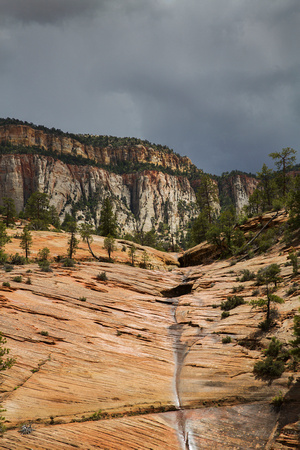
Image: Upper Zion, Canon 5D Mk III, EF 24-70 f/2.8L II
f/11, 65mm, 1/200 sec, hand held.

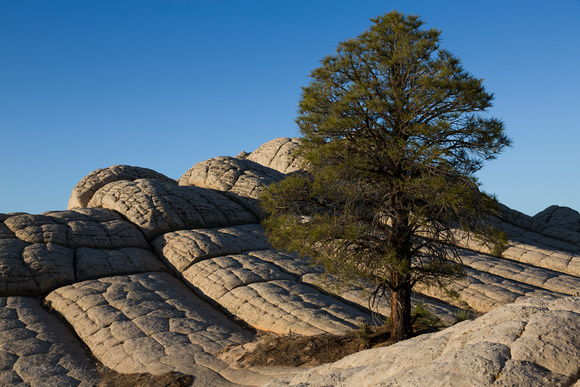
  Image: White Pocket, Canon 5D Mk III, EF 24-70 f/2.8L II 
f/11, 41mm, 1/160 sec, Tripod. 
Larger Image
See my first impressions here

Resolution, this lens provides lots and lots of resolution, the higher the quality of the glass that is in a lens, the better the resolution provided by that lens, the new 24-70 f/2.8L II provides oodles of it.

Sharp throughout, little distortion and no chromatic aberration make this a keeper lens, color rendition and micro contrast are also excellent, it beats its Canon stable mates and is a great all around lens.

From portrait shoots to wide landscapes, on a Canon full frame camera you cant beat it, I'll take it over three f/1.4 primes any day. Paired with the EF 16-35 f/2.8L II and the EF 70-200 f/4L IS, I don't feel a need for any thing else for a shoot in the back country.

Only downfalls are weight and cost, I got it with the $200 rebate after the priced dropped a little.

Its missing Image Stabilization, is that a downfall? not if it increased the weight and size, I shoot all critical images on a tripod where Image Stabilization does nothing and even in low light Image Stabilization isn't much help.
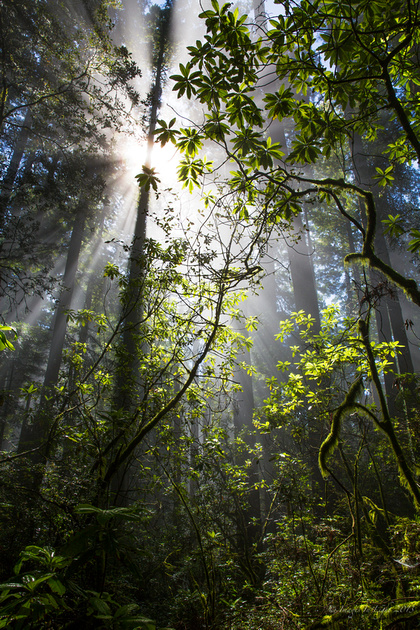
Image: Redwood Forest, Canon 5D Mk III, EF 24-70 f/2.8L II 
f/11, 24mm, 1/80 sec, Tripod. 

Oh and corner to corner sharpness : )

Wednesday, May 22, 2013

Composition


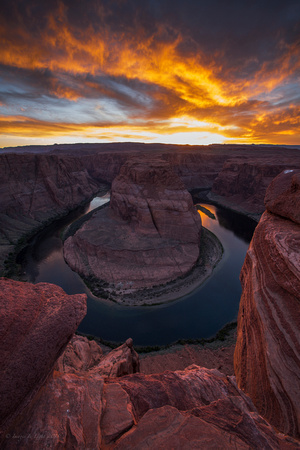
5D Mk III, EF 16-35 f/2.8L II,  f/14 for 1 sec at 16mm.
Lee 2 stop GND filter.

Larger Image

After getting back from my Utah/Arizona trip I Googled Horse Shoe Bend and to my surprise almost all the images that came up where shot in landscape mode, not the Portrait mode I saw while I visited precariously 1000 feet above the Colorado River, I'm thinking that most people want to get the cliffs on both the left and right sides of the canyon or want less sky (I was blessed with nice clouds) so I chose the above composition. 

I wanted some glow in the foreground rocks and tried to capture the fire in the sky, a Lee 6 inch graduated soft 2 stop neutral density filter held back almost enough of the light to not blow most of the sunset.

I came away from that one happy, it was kind of a last minuet decision to run down and shoot at Horse Shoe Bend as we where staying the night in Page. There must have been a couple dozen photographers perched on the edge of that drop that night, most had left by the time this scene had unfolded and the real color shown itself.

 Photog's at Horseshoe Bend

Ross

Monday, May 20, 2013

Slot Canyons less traveled


Buckskin Gulch, 5D Mk III, ef 24-70 f/2.8L II; 1/2 sec at f/5.6, 59mm ISO100,
on a tripod with B + W circular polarizer. 
 

Buckskin Gulch, 5D Mk III, ef 24-70 f/2.8L II; 1/3 sec at f/8, 65mm ISO100. 
 on a tripod with B + W circular polarizer.
A lot of us have heard of Antelope Canyon, well there are others, maybe not as beautiful, but they don't have hundreds of photographers jockeying for position and guides asking you to move on so some one else can have their turn.

Wire Pass, Buckskin Gulch and Paria Canyon in the Vermilion Cliffs National Monument is a series of slot canyons that allow for a peaceful hike that can last up to 6 days if you want with nary a photographer in sight if you get in far enough, spend some time in there and you'll come away with some beautiful images and you wont have to pay for the privilege, unless you decide to get a permit for an overnight trip.

Its located in Southern Utah and Northern Arizona and there are a great many other locations nearby like: The North Rim, South Coyote Buttes, The Wave, etc, etc... 


Ross

Images In Light

Wednesday, May 15, 2013

Sony DSC-RX100 Cyber-Shot

Larger Image
 Sony RX100, f/5.6, 10.4 mm, 1/640 sec, ISO 125, Program; Landscape.

 Sony RX100, f/5.6, 10.4 mm, 1/320 sec, ISO 80, Program; Aperture Priority.


Sony RX100 with Richard Franiec Grip

 A lot of people have been extolling the virtues of the Sony RX100, for good reason too, it is a fantastic little camera that has become my go to pocket camera, it takes phenomenal images for such a small package.

If this is the future of pocket cameras, I can hardly wait for what larger format cameras will be able to produce, Sony has enabled this camera to expose a very wide range of color and light, while producing sharp, contrasty images with the Zeiss branded optics.

It has a few quirks, but most cameras do, one in particular is the ability to accidentally press the movie button, the menu system is a little complex, but far better than a lot of other manufacturers.

Its a little camera and I have sausage fingers, so I'm told, so I recommend the  Richard Franiec Grip

Ross

Monday, May 13, 2013

More from White Pocket

Adobe's greed

Adobe wants us to go to a cloud based subscription for Photoshop, I for one will never pay Adobe on a monthly basis and will find other software that works, there is plenty out there, yes Adobe is the best but the others will improve to get our business.

sign this petition to let Adobe know your dislike for subscription based software:

Petition

Ross

Images In Light

Sunday, May 12, 2013

The Brain

5D Mk III, 24-70 f/2.8 L II 41mm at f/11, 1/160th sec
Larger Image


5D Mk III, 24-70 f/2.8 L II  27mm at f/11 1/40th sec
 Larger Image


5D Mk III, 24-70 f/2.8 L II  41mm at f/11 1/160th sec
 Larger Image

Its nice to go on a shoot in a place you have pretty much never heard of, no preconceptions or iconic images to think about, just a clean sheet to work with. White Pocket is one of those places, I saw only a few images of it before going, its a very hard place to get to, way out a high clearance road in Arizona, miles of deep sand, each year the route can change depending on conditions, pretty much impassible in the wet season and white knuckle driving the rest of the year.

Worth every minute of the drive to see such a unique landscape, one I would love to visit again.

Ross

Monday, April 22, 2013

Motion Stills

 1/80 at f/2.8, ISO 1600

 1/60 at f/2.8, ISO 2000

Using a still image to imply motion, a similar technique to shooting prop driven airplanes can be used to show the motion of an animal or person running, it takes a steady hand to shoot when moving in a car in low light, mine? not so steady : )

A low shutter speed of  around 1/60 of a second is about right to show Ducky's legs as blurred while keeping her head relatively sharp, auto ISO with a f/2.8 lens in low light worked out quite nicely for this series.

Ross 

Thursday, April 18, 2013

First Impressions, Canon ef 24-70 f/2.8L II


Ducky, 5D Mk III, EF 24-70 f/2.8L II at f/2.8, 1/60 sec, ISO 1250, natural light.

One of the reasons I wanted this new lens was for portrait work and Ducky was my first victim.

This is amazing resolution for ISO 1250, exactly what I was looking for in a lens

The hype about the new version II appears to be true, I will soon test it out in on some Utah landscapes and give it a real test, but so far I love it, I will probably be shooting with this one for years to come.

Ross 

Saturday, March 16, 2013

Lightroom


Lightroom is the most indispensable tool I have for processing images, all my work begins by using Lightroom, other programs include CS5 for final touches and Photo Mechanic for browsing (I use a MAC), I consider all three programs essential to my work.

You can see in the first example how much can be recovered from the shadows, that is a pretty extreme example, but it happens, the second is a lot closer to a normal exposure and much easier to handle when shadows and highlights are not clipped.

Adjustments are almost always very subtle when an image is exposed correctly, often a small tone curve adjustment along with shadows and highlights. In the case of the second image above, luminance was used to control contrast in the blue, yellow, red and orange, along with curve a adjustment,  then shadows and highlights. Sharpening always is left at the preset standard in Lightroom.

Sometimes trickier images that show an odd color cast may need a hue or white balance adjustment and there is the occasional image that needs a digital Graduated filter.

Ross
Images In Light


Friday, March 1, 2013

Why I shoot RAW


Final image after PS CS 5
Larger Image


RAW image converted in Lightroom 4 to 16 bit tiff


Original RAW Image, before processing.

Shooting in jpg only is like throwing away the negative, I always shoot in RAW format with my DSLR, I want to be able to get everything out of my files and RAW format stores a lot more information than a jpg does.

My original RAW files are selected and have the majority of processing done in Lightroom, highlight recovery and shadows, white balance, individual color luminosity, tone curve and a small amount of pre-sharpening.
This is where I may decide to do local adjustments in PS CS5, along with a very slight tone curve, crop and possibly print-sharpening. They are then saved in 16 bit tiff format for future printing or work and long term storage.

Local adjustments may include dodging and burning or a layer mask or slight color adjustments, PS CS5 is only used for images I select for possible future printing or as a select image for web presentation.

All images for use on the web are saved in jpg format. I may end up with several formats and sizes of each of my select images that get stored on an external drive.

Ross 


Wednesday, February 20, 2013

The so called Blue Hour


Images In Light: San Franciscoscapes &emdash; City View
Image: 5D Mk III, 24-70 f/2.8 L II, f/10,  20 sec

 Dancer
Image: 5D Mk III, 24-70 f/2.8 L II, f/ll, 13 sec

Tuesday, January 22, 2013

Falcon Attack

Falcon dives down from upper right. f3.2 1/800 sec.
Larger Image

Falcon is in the midst of the Sandpiper flock. f3.2 1/800 sec.

Flock is being divided and falcon now center above flock. f3.2 1/800 sec.

Flock divided moments later and the unlucky Falcon has left. f3.2 1/1000 sec.

Swarming Dunlin Sandpipers trying to protect themselves in numbers over the Puget Sound, the Peregrine Falcon tried several times to make a kill and failed.

Ross 

Wednesday, January 2, 2013

Night Photography

Image: 5D Mk III, 24-105 f4 L IS

Taking photos at night is mostly about getting focus, here I was setup on a tripod and set my focus on one of the windows, there was enough contrast for the auto focus to pick it up, I set my aperture to f7.1 to get a bit faster shutter speed.

 Image: 5D Mk III, 24-105 f4 L IS

 Again I got enough light on the window for auto focus to work and tried to maintain about 20 sec exposure to keep the stars pinpoint instead of streaks.

so some basic rules are keep the exposure as fast as you can at ISO 100, use a tripod, find contrast for your auto focus to work or switch to manual focus, if there are no stars or you want to impart movement somehow go with a longer exposure, if its very dark you may need to bump up your ISO to 1600 to get a faster shutter speed.

Its amazing what can be done with today's cameras, tomorrows, well ?.................

Ross

Wednesday, December 19, 2012

Giant image of Mt Everest

this is an amazing Image you can zoom in on base camp and camp 3

with this one follow the green box's until your viewing from a different location.

Ross