Showing posts with label lenticular cloud. Show all posts

Monday, October 24, 2016

Using a ND filter for long exposure


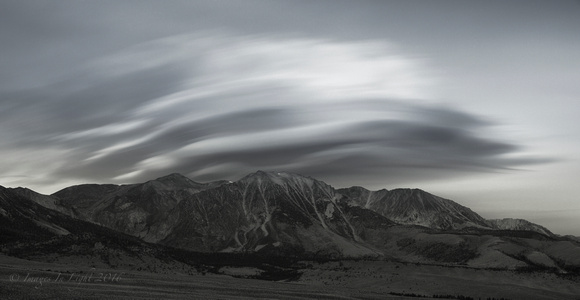
Images In Light: Latest Work &emdash; Owens Valley
 5D Mk IV, EF24-70 f/2.8 L  II, f11, 53mm, 30 sec
Processed  in Lightroom for monochrome and split toned.

When imaging a scene with lenticular clouds like this one, I like to use a long exposure to exaggerate their circular rotation. Here I used a Lee 6 stop ND filter to extend the exposure time to 30 sec. Instead of the wispy clouds, I got more of the circular motion of the whole storm system.

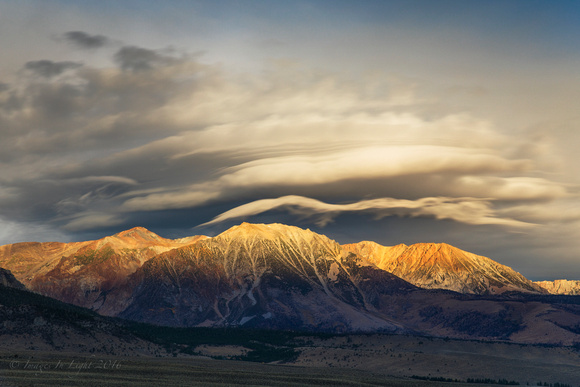
This was predawn light, so my original exposure would have been a couple of seconds at f/11, not long enough to get the full range of motion. The below image was a similar exposure taken after the sun came up and the exposure time difference with the same setup was 27.5 seconds, for a 2.5 sec exposure.

Images In Light: Latest Work &emdash; Sunrise before the Storm
5D Mk IV, EF24-70 f/2.8 L  II, f11, 70mm, 2.5 sec

Of course its all a matter of personal taste, I happen to like both, I also have a shot at normal exposure speeds without an ND filter and like those as well. This is just one example of the use of an ND filter and why they should be in every landscape photographers bag.

Ross

Sunday, March 20, 2016

Hand Held Landscapes


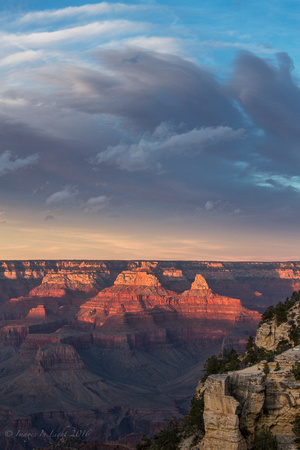
Hopi Point, Grand Canyon National Park
Image: 5D Mk III, EF 24-70 f/2.8, 33mm, f/7.1, 1/250 sec, hand held.

Larger Image

Hopi Point, Grand Canyon National Park
Image: 5D Mk III, EF 70-200 f/4, 81mm, f/11, 1/20 sec, tripod.

I have found that I need to shoot at at least 1/500 of a second and use very good technique in order to get a print quality image hand held. A tripod is a must for conditions that are not very bright, even image stabilization is not enough to get a tack sharp image hand held in low light. The upper image can be printed at probably 24 inches (hand held at 1/250 sec), while the lower image can probably be printed at 36 inches (tripod at 1/20 sec).

Some times an image can be shot sharper hand held, I shot the upper image hand held and on a tripod, the wind was blowing at about 20 mph and it was obvious to me that shooting on a tripod was not working out so well, so I switched to a larger aperture, hand held and got the faster shutter speed and also took the wind blown tripod out of the equation. Later when the wind died down I was able to shoot back on my tripod and get sharp images.

Ross 

Tuesday, March 17, 2009

Sharpest zoom ever ? - Canon EF 70-200 f4 L IS


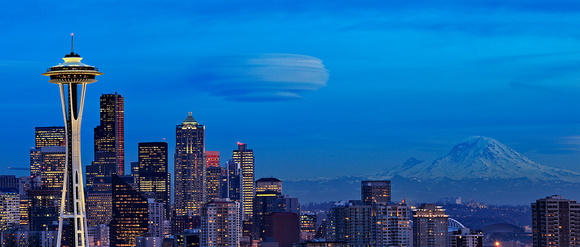
Photo: 5D MkII and 70-200 f/4L IS, 2 shot panorama

Maybe,
One of the eternal questions for Canon owners is which 70-200 should I get ? Of the 4 to choose from, they are all very good, but with a range in cost of $500 to $1700 how does one choose ?, I have had the 70-200 f2.8 L, 70-200 f2.8 IS L and presently the 70-200 f4 IS L. All three of these len's where sharp. I purchased the original back in my film days and enjoyed it, at one point it was stollen so my re-purchase was the 2.8 IS version (at the time there was no f4 IS), the "IS" or image stabilization is an amazing feature that works exceptionally well. So I had a trip comming up and this caused a problem, which lens's to take with me ? I realy wanted to take the 17-40, 24-105, 70-200, 300 f4 and one body, but these would not all fit in my bag of choice, not to mention the weight would be prohibative to pack around all the time. My solution ? buy the 70-200 f4 IS, try it out and sell the loser. keep in mind that for me the bokeh of the f2.8 was not that important, I have other lens's for portrait shots and the 1 stop differance between f2.8 and f4 is not enough to matter for low light shooting, for that you want f1.4 len's. So after recieving the f4 IS version and trying it out on a skyline shot of Seattle I became convinced, at half the weight, a $600 savings, one stop better image stabalization and getting a sharper lens, to me there was no competition, I sold the f2.8 IS version, in a perfect world I would have kept both, but in these times of economic turmoil, not going to happen. Oh and this allowed me to fit all the lens's I wanted in to my carry on bag, and made my life a lot easier.
So if you want one of these lens's you need to juggle, weight, cost, speed and image stabilization, as far as IQ is concerned, they are all very nice and you can't go wrong there. If its portrait work, its got to be one of the 2.8 versions, I think for most other applications f4 should suit most people fine. Photography has always been about trade offs, this is just another one those.

My recommendations are as follows:

for portrait work: 70-200 f/2.8L IS II

for all other work: 70-200 f/4L IS

for cost saving: 70-200 f/4L


Update: the newest member, the EF 70-200 f/2.8L IS II, at around $2300 trumps them all, yes its worth it, I upgraded to the EF 24-70 f/2.8L II and it is also well worth the money.

Kai says it all here 

Ross Murphy

Images In Light

The Digital Picture Review