Friday, October 30, 2009

Perspective

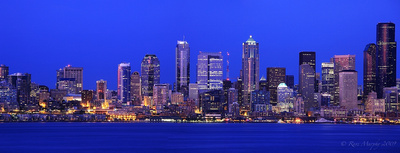
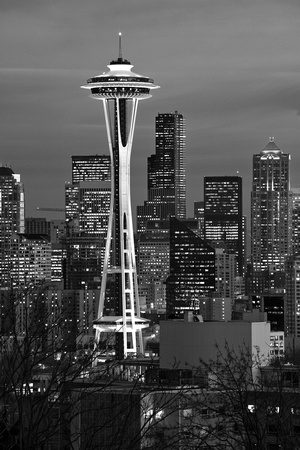
Image: 5D Mk II, 24-105 f4 IS L at 35mm

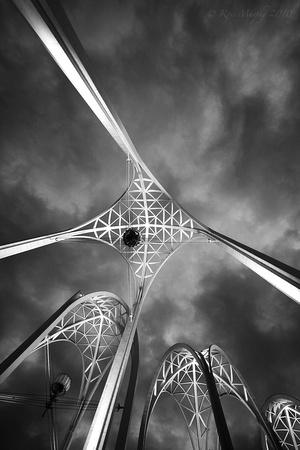
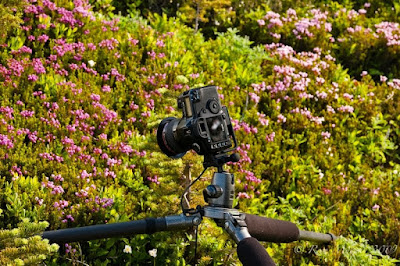
Image: 5D Mk II, 24-105 f4 IS L at 58mm

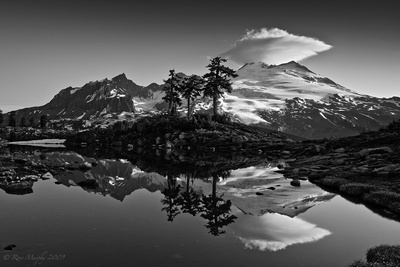
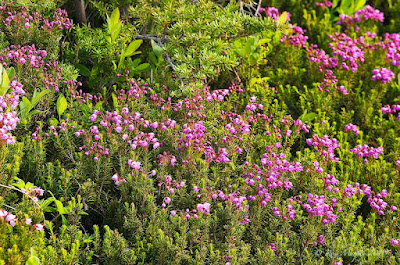
Image: 5D Mk II, 24-105 f4 IS L at 105mm

Perspective will say a lot about an image, the above shots taken from Denny Park show 3 different perspectives of Seattle, each telling there own story. When shooting an image think about what you want to convey to the viewer, what image in your mind is it that you want them to see, each of these shots will feel a little different going from wide, to close in, one showing the Salish Sea as it is now known and the last showing a more intimate view giving perspective to the city's proximity to Mt Rainier.

Ross Murphy Images In Light

Tuesday, October 20, 2009

Fall at Mt Rainier NP

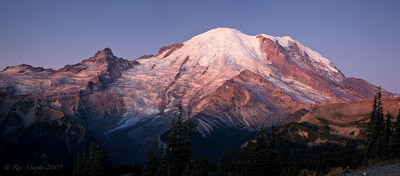
Image: 5D Mk II,300 f4 IS L at f4,spot metered, ISO 400, 1/250 sec click to view larger
Image: 5D Mk II, 16-35 f2.8 L II, 18 mm at f16, 3 stop GND soft, click to view larger.
Image: 5D Mk II, 16-35 f2.8 L II, 33 mm at f16, click to view larger.

Again another day of bad weather at the Mountain, was only able to get 5 shots off with the Mountain in the image, but it was still better than a day in the office, ran in to a black and silver phase Red Fox and a Black bear on this trip and enjoyed a quiet hike in Paradise valley, pretty much all to my self, the colors where a little beyond peak up high but still nice lower on the Mountain. The weekend before I got snow, so a little better this trip.

Ross Murphy Images In Light

Sunday, October 11, 2009

Winter Forest


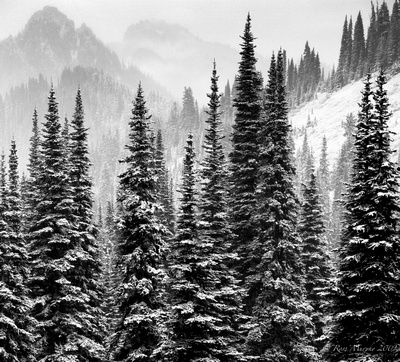
Image: B and W Forest, 5DMkII, 70-200 f4 IS L at 116 mm, f11
Well, what I thought was going to be the last chance to shoot fall color at Mt Rainier, turned in to a cold a snowy day with the temperature right at 32 deg. Paradise valley (above) was cold and moody, it turned out to produce some interesting compositions including this on that I cropped to remove the trunks of the trees and the square format worked nice. See the full image here.

Ross Murphy Images In Light

Wednesday, October 7, 2009

More from Shuksan


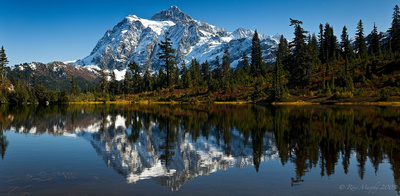
Image: 5D Mk II, 24-105 f4 IS L at 50mm, CPL and 3 stop GND soft
This is an image I have been wanting to get with the 5D Mk II, its a 2 shot panorama of Mt Shuksan with the fall colors and fresh snow on the mountain, I look forward to getting this one printed and framed. The 24-105 f4 at 50mm is deadly sharp on the Mk II and is a combination thats hard to beat. Right now I am very happy with the lenses I have, I do wish I could afford a 400mm f4 DO. Canons f4 series of lenses are a blessing for outdoor photographers that want to travel light and the cost is a blessing also over their f2.8 cousins.

Ross Murphy Images In Light

Sunday, October 4, 2009

Fall has Arrived


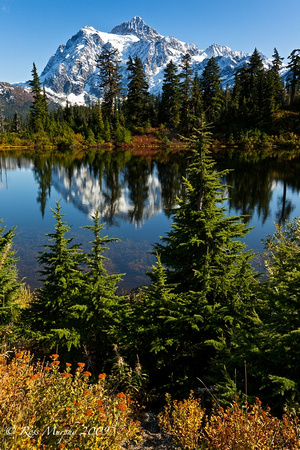
Image: Fall At Mt Shuksan 5D Mk II, 24-105 f4 IS L, at 35mm, 3 stop Soft GND, 1/20s, f 22.
Larger Image


Probably my favorite type of image to shoot is the portrait mode landscape with foreground interest, this one has a lot to look at in both fore, mid and background, shot at f22 for maximum depth of field.
A great place to shoot, taken around 3:00 this afternoon, the most photographed mountain in the US, so I hear. Part of the North Cascade range and in close proximity to Mt Baker, about 3 hours north of Seattle.

Ross Murphy Images In Light

Sunday, September 27, 2009

Skunked Again !


Image: 2 shot panorama, 5D Mk II, 24-105 f4 IS L at 58mm, f11, 30 sec.


Clouds, I want clouds when I go on a shoot, this year has been nothing but total blue skies, I'm getting a little ticked off, but hey, some times you get the right conditions, some times you don't, maybe this means next time it will be stellar, we'll see, hope your having better luck

Ross Murphy Images In Light

Monday, September 14, 2009

Foreground

Image: 5D Mk II, 16-35 f 2.8 L II, 30mm at f11 for 2 sec, CPL and 3 stop GND soft. Just prior to sunrise.

Foreground in an image like this can make or break it, I was unlucky with cloud cover but managed to get an interesting image by using the foreground to add interest, I exposed on the whole scene and recomposed and focused on the plants on the surface of the water, I used live view with exposure simulation, which I am starting to use more of, it works very well, Canon has done an excellent job with live view. I think I have come to like the 16-35 f2.8 L II, it is quite sharp and I can stop it down to f16 or more and have less diffraction than the 17-40 f4 L.

Ross Murphy Images In Light

Wednesday, September 9, 2009

Patagonia


Iconic Patagonia
Mt Fitzroy,
Torres Del Paine,

Just some of the iconic names that come to mind from the southern tip of South America, Chile and Argentina's wonder land of ice and stone. Maybe the worlds greatest place to shoot landscapes of mountains, glaciers and exotic wildlife. I am looking for some intrepid souls, interested in traveling to this incredible place, when its winter up here in Seattle its summer in Patagonia, if I can find the people to go I will set up the photographic trip of a life time, whether you are a beginner or an expert, the means and the will to do a trip like this is what I'm looking for. Just so you know I am well traveled and have been to Central and South America, Africa and Europe, so I know what it takes to set this up and I know the basic locations to shoot, from Laguna Torre and Pehoe, to Los Glaciers NP, this trip will include hiking so you must be in good physical condition (not to extensive), this may be my first trip to Patagonia, but it wont be my last.

If interested, let me know via e-mail or this post.

Ross Murphy Images In Light

Thursday, September 3, 2009

MFT or M4/3 = Micro Four Thirds Cameras


Top image: sensor sizes of various digital cameras
Bottom image: 2 recent examples of MFT cameras
The Micro four thirds standard, a derivative of the Four Thirds system, was set up by Panasonic (Lumix) and Olympus, its similar in size to the APS-C system used by most of the other camera makers (see above chart), lenses and most accessories will be interchangeable between the companies :) what is most unique about this system is its small size for a DSLR but they have no mirror, the LCD is used to view or an electronic view finder, beyond the size advantage of the system is image quality, compared to digital point and shoots, as you can see above, the sensor of the MFT is much larger than the typical point and shoot of 1/2.5 - 1/1.7 , this allows for much better image quality and at the same time allowing a much smaller form factor. (for details see white paper) This is a camera for those that want to travel light and still come back with good image quality, if used right these will give fantastic photos, if used wrong, like any camera, you will be disappointed. I think this system holds real promise and I would like to give it a try and see if its something I would hold on to and use. Currently there are 4 cameras to choose from in this size sensor. the EP-1, G1, GH1 and the new GF1, the later being what I would like to try, another interesting aspect is you can get adapters for almost any lens, so you could mount a Canon 300mm f4 IS L and have the field of view of a 600mm f4. You can also put some serious Leica glass on these cameras with the adapters or without.
See some upcoming lenses here at a Japanese site DC Watch.
Finally something new for us gear heads :)

Micro Four Thirds standard White Paper

Ross Murphy

Images In Light

Wednesday, September 2, 2009

More About Panoramas

Image: crop from image just below this. click image to view larger.


Image 5D Mk II 70-200 f4 IS L, 5 Shot panorama. click image to view larger.

Image 5D Mk II 70-200 f4 IS L, 2 Shot panorama.

Larger Image

Here is a good reason not to shoot panoramas to wide, if you plan on framing the top, 5 shot panorama, it would cost a fortune at 17" x 62" which is where you would need to be to have a decent height where the lower 2 shot panorama could be printed at a much more manageable size of 17" x 31", it is also much better for viewing on line, I try to max my horizontal panoramas to 3 shots with overlaps. Now if I do portrait mode panoramas I will do a minimum of 3 to 5 shots and preferably 7 seems to be about right in portrait mode and I would have done it here but the water was to rough and there was no reflection to speak of. Shot on a Gitzo 3530s tripod with a BH-1 ball head, stitched in CS4. The big one is fun to view on 2, 20" monitors though I must admit, the detail is pretty amazing. Glass size also comes in to play, limiting my images to about 42" in length, without inducing massive extra cost.

Ross Murphy Images In Light

Saturday, August 29, 2009

Canon 7D APS-C and a fast 8 frames per Second.


New Canon EOS 7D
18mp APS-C CMOS
Dual DiGiC 4, 14bit
8fps, 94 large fine jpegs or 15 RAWs
19 points cross type AF sensor. Center AF point uses cross plus X type AF sensor
ISO 100-6400, extend to 12800
100% coverage, 1.0x opitcal viewfinder with smart information display.
3.0‘ LCD, 920,000 dot
New iFCL metering system, brightness and color
150,000 shutter life cycle
internal e-ttl flash control

Could be interesting, but I will have to see how they handle image quality with 18mp on an APS-C camera, also a trio of lenes including an EF 100 f2.8 IS L Macro with a pair of EF-S zooms.
The Pro type auto focus sure looks nice, birders and sports photog's will love this one. Basically it looks like a Pro Crop camera with some interesting new features including: electronic level, color metering, duel processor, %100 view finder and more. Fully sealed ? sounds like it.
Diffraction Limit f/6.8
Crop 1.6x
Pixel size 4.3µm
Image size 5184 x 3456
Info Video at Canon
See it at Canon Canon 7D

Down load the manual here
Buy it Here at B and H.
Ross Murphy Images In Light

Monday, August 24, 2009

Black and White


Image: Seattle B and W, 5D Mk II, 16-35 f2.8 L II..

Larger Image


Image: Mt Baker, 5D Mk II, 17-40 F4 L, 3 Stop GND soft. B and W in Lightroom and CS4.

Larger Image


Black and white is something I have become fond of lately,the images evoke a different emotion than color and I'm at a stage where I want to experiment a little more and try to put more feeling in to my work, I am not yet happy with the way I process the images, but I am experimenting with different ways, the above image was taken B and W in camera and processed with DPP and CS4, my other options include Lightroom, but I am yet to come up with a combination I like for my final work flow, so a little more research and some playing around I hope to come up with the right recipe. Getting just the right look and feel to a black and white image is harder than color images in my opinion. The best thing that digital has given me is the ability to experiment with out the cost of film.

Ross Murphy Images In Light

Sunday, August 16, 2009

Fall is Coming whether we like it or not


Image: Fall Aspen in Grand Teton, 50D, 300 f4 IS L.

Larger Image

Fall may be the best time of year to get out and shoot landscapes, I'm having a hard time trying to decide on where to go, but I think I may end up in the Canadian Rockies and Glacier N.P. Montana, I just fell in love with that place last year, but most places, at least in the Northern hemisphere have fall color to shoot in late September and early October, even out in the desert South West, as a matter of fact the Pacific North West has some great fall color, to see it you need to get up in the mountains or on the east slope of the Cascade range. Probably the best here would be the Alpine Lakes Wilderness or the Mt Baker area along with Mt Rainier National Park.
So make your plans now and be ready, its a short window of time. The above image was taken in the first week of October last year in Grand Teton N.P. Wyoming. For you photog's in the Southern hemisphere, well you have spring coming up, the other great time of year to shoot. One of these days I will shoot Patagonia in the fall, if some one wants to invite me down just drop me a line....

Ross Murphy Images In Light

Tripods,Ball heads and L-Brackets


As a landscape photographer, there are some tools that you just have to have if you want to get sharp images: Tripod, Head, Bracket. There is a dizzying array of options out there. Lets start with the tripod, now keep in mind this is from a landscape point of view. I chose a Gitzo 6x carbon fiber 3 leg with a flat plate, the reason behind my choice, the G3530s was light weight, 3 leg extension for better stability, flat plate with no center column again for better stability, short folded up length and finally its ability to hold a large lens, as with everything it has its shortcomings but I found it to be the best compromise for my work. Next I needed a system for mounting my camera and the main system is the Arca-Swiss style mount which several manufacturers have adopted for use, including Arca Swiss, Really Right Stuff and Kirk Enterprises, just to name a few. My choice was with Kirk Enterprises, for cost, design and build. The BH-1 is simple and robust, it does what its intended and will stand up to being abused and keeps on ticking, even after a pretty good fall from the top of my jeep. One last item is the way you mount your camera to the ball head, you have two options with the mounting plate on the ball head a Single Plate or an L-Bracket, really its one choice and that is the L-bracket, this allows quick change from portrait to landscape mode, it also acts as a little roll cage for your camera as a little bonus (note: remote shutter release can still be used with L-bracket). With this set up you can backpack, shoot a city or do Panoramas or long exposures and you wont have to buy another set up for a long time, most photographers go through buying several before they figure out that they should have got a good one to start, including me. This will give you a rock solid mount at a reasonable cost and a good weight. A good alternative and less expensive ball head is the Gitzo with a Universal Quick Release Clamp installed on it, like the above image.

Ross Murphy Images In Light

Tuesday, August 11, 2009

Portrait mode vs Landscape mode

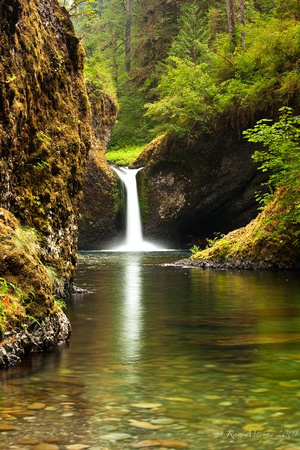
Image: 5D Mk II, 70-200 f4 IS L, CPL, 3 stop soft GND filter,70 mm @ f16


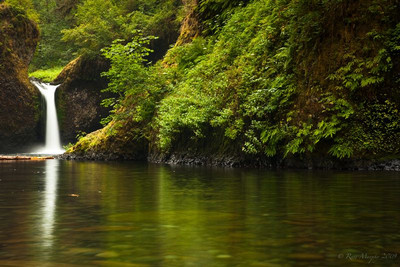
Image: 5D Mk II, 24-105 f4 IS L, CPL, 3 stop soft GND filter,67 mm @ f16


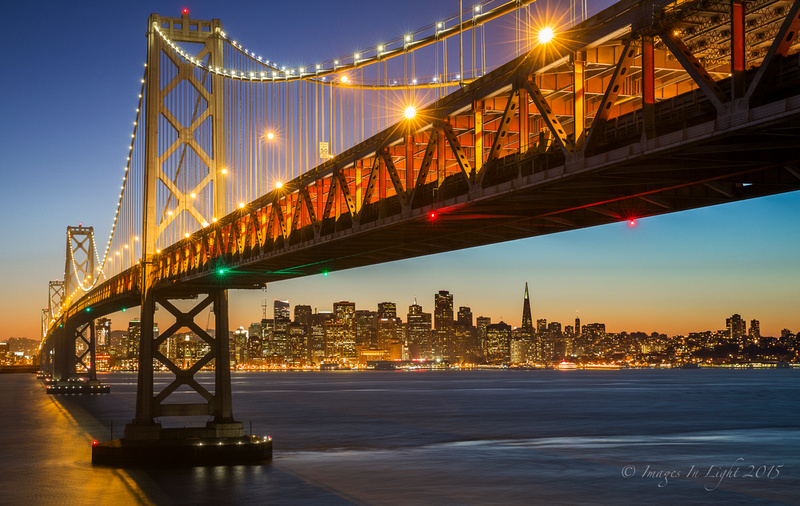
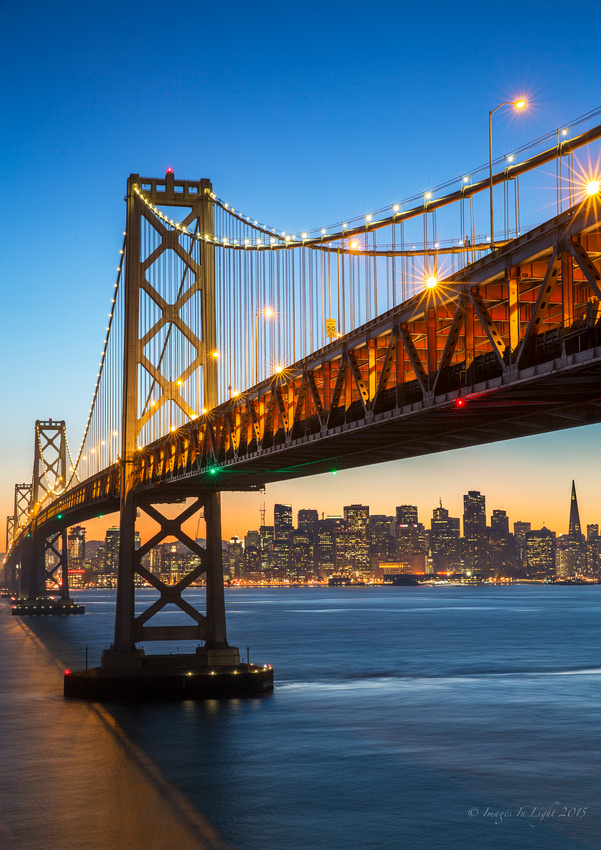
Shooting landscape or portrait ? Last weekends trip down to the Columbia River Gorge made me think a bit more about this. I now shoot mostly in portrait mode, I just seem to prefer it, some images demand one or the other and some times I like to see an image stretched across two screens. What do pro's do, well if your shooting for a magazine cover you would want to shoot portrait, for a fine art print, you could go either way, for a stitched panorama, I also prefer to shoot 5 portrait mode shots or two landscape mode shots, I think print size plays a big roll also, portrait mode shots, I feel, look better than landscape in sizes at or below 12 x 18, above that either way works for me. So when out shooting try both, see what works for what type of landscape. The lower of the two shots above is one half of a panorama.

Another example:

Images In Light: San Franciscoscapes &emdash; The Bay Bridge H


Images In Light: San Franciscoscapes &emdash; The Bay Bridge V


Ross Murphy Images In Light